
Guide · Grounding techniques
A complete guide to grounding techniques for panic
When panic hits, it can feel like your mind leaves the room. Your thoughts race ahead to the worst version of the next ten minutes, your body acts like there's an emergency, and the actual room you're sitting in sort of fades into the background. Grounding is the name for a family of small, simple skills that bring your attention back to right here, right now. They don't make panic vanish on command. What they do is give your attention a handrail while the wave rises, peaks, and falls on its own.
This guide pulls together the grounding tools our community uses most, explains why each one tends to help, and offers a way to choose one when your brain is too loud to think clearly. Nothing here is a cure or a treatment plan. It's what people who live with panic have found useful, written in plain words.
What grounding actually is (and what it isn't)
Grounding means using your senses, your body, or simple facts about your surroundings to anchor your attention in the present. During a panic attack, the alarm system in your body is acting as if there's danger. Your attention narrows onto the scary sensations: the pounding heart, the tight chest, the dizzy head. That narrowing makes every sensation feel bigger, which makes the alarm louder. Grounding gently widens your attention back out.
Grounding is not about fighting the panic, pushing it away, or proving you're fine. If you treat a grounding tool like a switch that has to work right now, you'll probably end up checking every few seconds to see whether it's working, and that checking keeps the alarm going. A better way to think about it: grounding is something to do with your attention while the wave passes. The wave passes either way. Grounding just makes the ride a bit less lonely and a bit less chaotic.
It also isn't a replacement for care. If panic attacks are frequent, getting worse, or keeping you from living your life, talking with a doctor or therapist is a strong, reasonable step. Grounding works alongside that kind of help.
Why grounding tends to help during panic
There are a few plain reasons these tools help so many people:
- They give your attention a job. A racing mind does better with a simple task than with the instruction "just relax."
- They bring in neutral information. The color of a mug or the texture of your sleeve isn't scary. Every bit of neutral information makes the moment feel a little less like an emergency.
- They interrupt the what-if loop. It's hard to count blue things and catastrophize at full speed at the same time.
- They remind you where you actually are. Panic often brings a sense of unreality. Naming real things in a real room helps you feel placed again.
Sense-based grounding tools
These use what you can see, hear, touch, smell, and taste. They're the most popular starting point because they work almost anywhere.
The 5-4-3-2-1 method
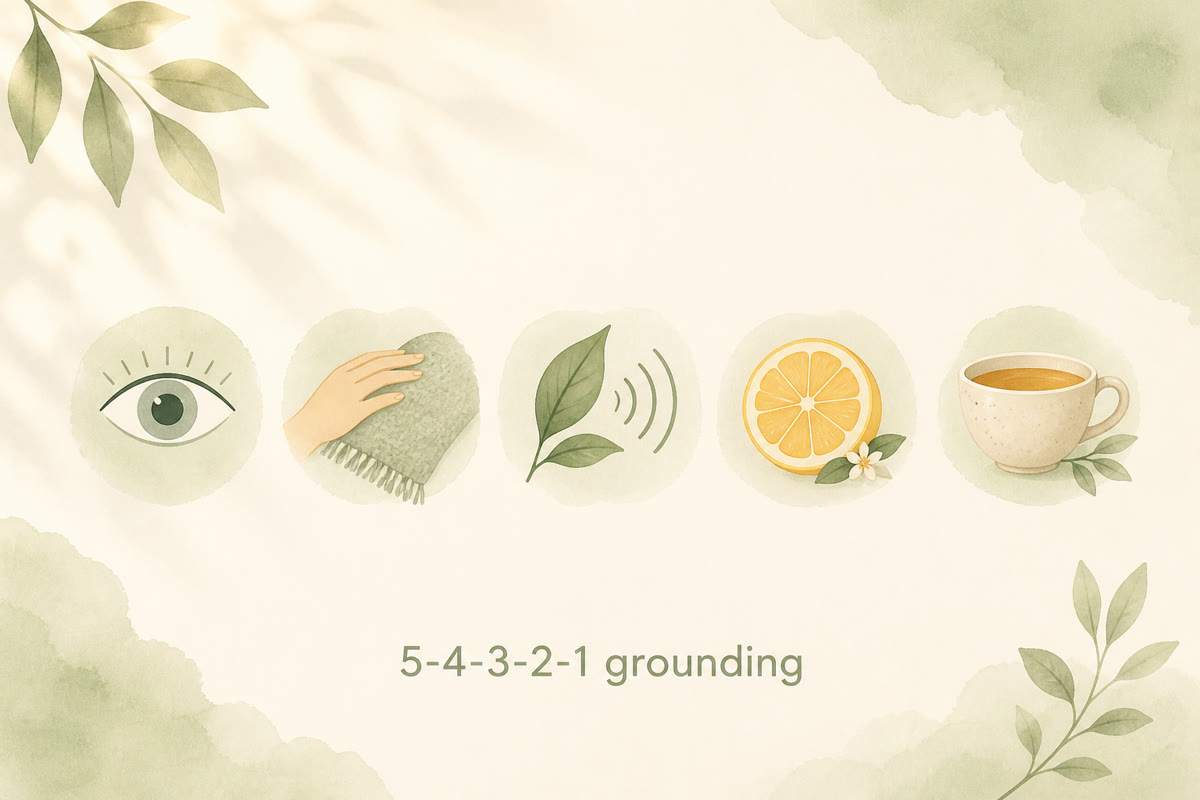
Name five things you can see, four you can feel, three you can hear, two you can smell, and one you can taste. Go slowly. You don't need to finish all five steps, and you don't need to get it "right." If you lose count, start again from wherever you are. We have a full walk-through in our 5-4-3-2-1 grounding guide.
Name three of one thing
When the full 5-4-3-2-1 feels like too much, choose one sense and name three things. Three colors you can see (here's how), three sounds you can hear (here's how), or three textures you can feel (here's how). Smaller tasks are easier to hold onto when your brain feels foggy.
Temperature
Many people find that a change in temperature cuts through the noise. Holding something cool, sipping cold water, or running cool water over your wrists gives your body a strong, clear signal to notice. Our cool water on your wrists post and cold water reset explain the simple versions. Skip anything that feels harsh, and if you have a heart condition or other health concerns, check with your doctor before trying strong cold.
Scent
A familiar, pleasant smell can work as an anchor: a lotion you like, a cup of tea, a sprig of something from the garden. Some people carry a small scented item for this. The point isn't the specific scent. It's having one steady thing to notice while you breathe.
Widen your gaze
Panic tends to narrow your vision. Softening your eyes and noticing the edges of the room, the ceiling corners, and the floor near your feet can feel like letting the room back in. Try it with our widen your gaze post, or the related look left, look right tool.
Body-based grounding tools
These use pressure, posture, and gentle movement. They're helpful when looking around feels impossible or when you're in public and want something discreet.
Feet on the floor
Press your feet into the floor and notice the pressure. Notice the floor holding you up. This is one of the quietest tools there is, and you can do it at a desk, in a car (when parked), or in line at the store. See feet on the floor.
Press your palms together
When your body feels buzzy and shaky, press your palms together gently for a slow count of five, then let go. Repeat a few times. That restless energy gets something steady to push against. Full post: press your palms together.
Release the brace
Panic often comes with bracing: clenched jaw, raised shoulders, tight fists. You don't have to relax everything. Just pick one spot and let it soften a little. Try soften your jaw, drop your shoulders, or open your hands.
Butterfly hug
Cross your arms over your chest and tap slowly, left then right, like a gentle heartbeat. Many people find the rhythm soothing when thoughts are racing. Here's the butterfly hug walk-through.
Gentle movement
If sitting still makes the panic feel trapped, slow movement can help: walking to the end of the hallway and back, rolling your shoulders, or a few easy stretches. Movement gives the alarm energy somewhere to go. See gentle movement for panic.
Breath-based grounding tools
Breathing tools work best when they're gentle. Forcing big, deep breaths can make some people feel more lightheaded. Focus on a slower, longer out-breath instead.
- Longer exhale. Breathe in softly, then let the out-breath be a little longer than the in-breath. See exhale longer.
- 4-7-8 breathing. A structured count some people like once they've practiced it on calm days. See 4-7-8 breathing.
- Hum on the exhale. A low, slow hum as you breathe out gives your breath a shape and gives your ears something to notice. See hum on the exhale.
If any breathing exercise makes you feel worse, stop and switch to a sense-based or body-based tool. That isn't failing. It's choosing the right tool for you.
Thinking-based grounding tools
These use words and facts. They suit people who calm down when their mind has something concrete to hold onto.
- Name where you are. Quietly say the room, the building, the street, and the town. It helps when the room feels unreal. See name where you are.
- Name the wave. Say to yourself, "This is a panic attack. It's uncomfortable, not dangerous. It will peak and pass." See naming the attack and false alarm.
- Category games. Name animals from A to Z, or every city you've visited, or the players on a team you like. It's silly on purpose. Silly is fine.
- Describe an ordinary object in detail. Pick up a pen and describe it as if to someone who has never seen one: weight, color, ridges, the click.
How to choose a grounding tool in the moment
When panic is loud, choosing feels hard. A simple rule of thumb that many people in our community use:
- If your mind feels far away or the room feels unreal, start with sight or place: name three colors, or name where you are.
- If your body feels buzzy, shaky, or restless, start with pressure or movement: palms together, feet on the floor, a slow walk.
- If your body feels hot and flushed, start with temperature: cool water on your wrists.
- If your breath feels stuck, start with a gentle longer exhale or humming, not big gulps of air.
- If nothing seems to land, pick the smallest tool you know and repeat it. Small and repeated beats clever and complicated.
Practice when things are calm
Here's the honest part: grounding tools are much easier to use during panic if you've tried them on ordinary days first. When your alarm is going off, your brain reaches for whatever is most familiar. If you've practiced naming three sounds while waiting for the kettle, that tool will be easier to find later.
Some ideas for low-pressure practice:
- Pick one tool a week and try it once a day for a minute.
- Pair a tool with something you already do, like brushing your teeth or waiting at a red light.
- Write your two favorite tools on a card or in your phone notes so you don't have to remember them under pressure. Our calm-down kit guide has more ideas for keeping tools close.
Common worries about grounding
"It didn't work, so it's useless for me."
Grounding often doesn't feel like it's working while you're doing it. Many people only notice afterward that the wave passed a bit sooner or felt a bit less scary. Try judging it over several weeks, not one attack.
"I feel silly doing it in public."
Most grounding is invisible. Pressing your feet into the floor, naming colors in your head, or softening your hands looks like nothing to anyone else.
"What if grounding makes me notice my symptoms more?"
Some people find body-focused tools make them hyper-aware of their heartbeat. If that's you, lean toward outward tools such as sight, sound, and place, rather than inward ones.
Where to go next
- New to panic? Start with what to do during a panic attack once it's started.
- Want the bigger picture? Read our guide to panic attacks and panic disorder.
- Panic at night? See panic attacks at night: what helps.
- Helping someone else? See how to support a loved one during a panic attack.
- Want something interactive? Try the tools on our Tools page.
You've gotten through every wave so far. Grounding won't make you a different person. It just gives you something steady to hold onto while you get through the next one.