 Help My Attacks
Guide · Panic attacks & panic disorder
Panic attacks and panic disorder
A panic attack can feel like your body hit every alarm at once — heart racing, chest tight, breath short, mind convinced something terrible is happening. Many people describe it as a false emergency: intense, real in the body, and still not proof that you are dying or “losing it.”
This page is a calm, plain-language overview of panic attacks and panic disorder. It is written as peer support from Help My Attacks. It is not a diagnosis, a treatment plan, or a substitute for care from a licensed clinician.
What a panic attack is
In everyday words: a panic attack is a sudden surge of fear that peaks quickly. Your nervous system flips into fight-or-flight — the same protective gear that would help if you were in real danger. During a panic attack, that gear can fire even when the room is safe.
People often say it feels like a heart attack, like they cannot get enough air, or like they might faint or lose control. The sensations are loud. The story the mind tells (“something is terribly wrong”) can be louder still. Naming the pattern — “this is panic, a false alarm” — does not erase the fear, but it can give you a handrail while the wave moves.
Panic attack vs anxiety that builds
Anxiety that builds tends to gather over minutes or hours: worry stacks, muscles stay braced, the “what if” tape loops. A panic attack more often arrives like a spike — abrupt intensity that climbs fast, then softens.
Both can share a racing heart, tight chest, or shaky hands. The difference is less about which feelings “count” and more about how suddenly the surge shows up. Everyday language sometimes calls any intense wave an “anxiety attack.” Clinicians usually reserve “panic attack” for that sudden peak pattern. Either way, you deserve tools and kindness.
What panic disorder means
Having a panic attack does not automatically mean you have panic disorder. Panic disorder, at a high level, is when unexpected panic attacks keep showing up, and the fear of the next one starts to shrink your life — worry between attacks, checking your body, avoiding places or situations that feel linked to panic.
Only a qualified professional can diagnose panic disorder. If attacks are repeating, if you are rearranging your days around fear of panic, or if you are unsure what is going on, that is a good reason to get checked — not a reason to self-label from a webpage.
Symptoms of a panic attack
Bodies and minds show panic in different mixes. Common physical signs include a racing heart, tight chest, short breath, shaking, sweating, and nausea. Many people also feel intense fear, a choking or smothering sensation, fear of losing control, or a sense of being unreal or detached.
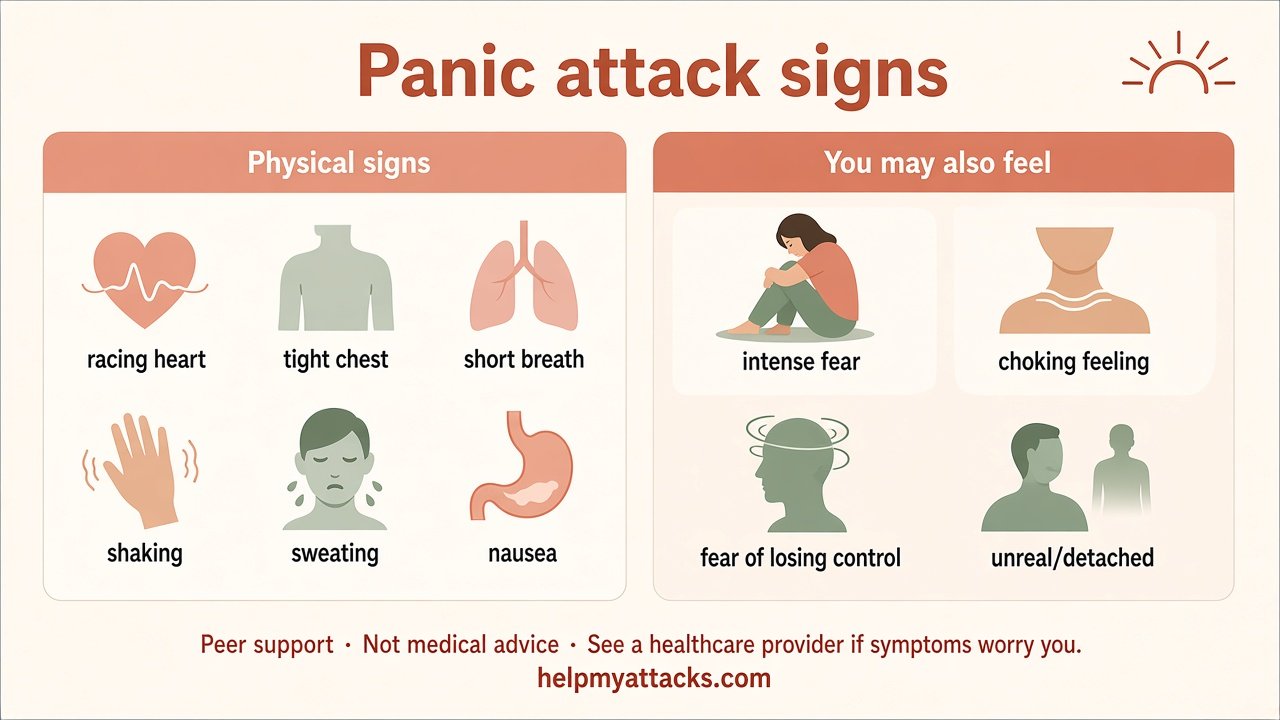
You do not need every item on a list for an episode to be real and exhausting. If a symptom is new, severe, or different from your usual pattern — especially chest pain — get medical care so other causes can be ruled out.
How long a panic attack lasts — peaks and passes
Most panic waves climb quickly, crest within minutes, and then ease. Many people notice the sharpest intensity within about ten minutes, with the body settling over the next stretch of time. Tiredness, wooziness, or “what if it comes back” can linger after the peak. That after-wave is common; it is not proof that something new and dangerous just started.
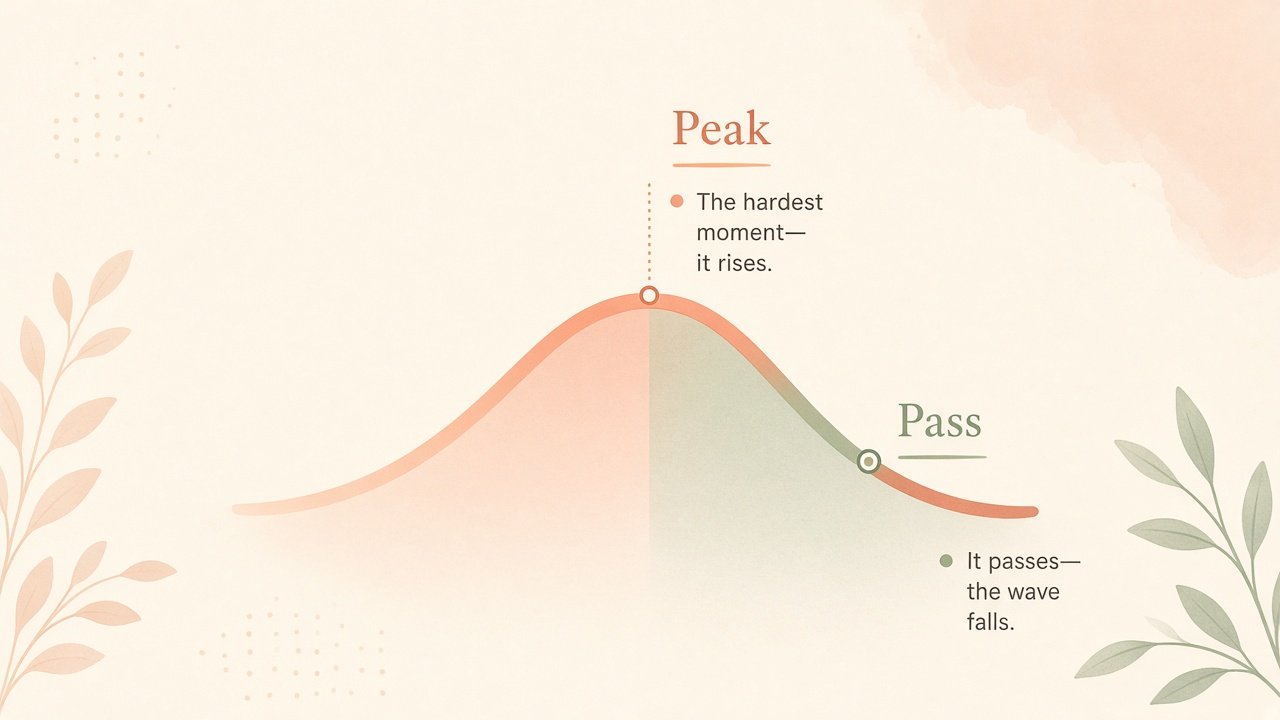
You do not have to wait for perfect calm. Staying with yourself while the intensity drops — longer exhales, feet on the floor, a simple name for what is happening — is enough of a job for those minutes.
Why panic happens (high level)
Panic is not a character flaw. At a high level, it involves a nervous system that can over-fire the fight-or-flight response. Stress loads, major life changes, sleep debt, caffeine, illness, and past frightening body sensations can all make that alarm easier to trip. Family history can raise risk for some people. None of that means you caused your panic or that you are stuck with it forever.
Understanding “false alarm” does not magically shut the alarm off. It can make the next wave a little less mysterious — and that alone helps many people stay kinder to themselves while they learn tools and get care.
Getting checked / when to seek care
- Emergency care now: new or unusual chest pain, fainting, severe trouble breathing, or any symptom that feels like a medical emergency. Do not wait for a webpage to decide — call emergency services.
- See a healthcare provider: if panic attacks are repeating, if you are avoiding daily life, if you are unsure whether something physical is involved, or if fear of the next attack is taking over.
- Crisis support (U.S.): call or text 988 for the Suicide & Crisis Lifeline. If you are in immediate danger, call emergency services.
A medical visit that rules out other causes can also make it easier to trust the “this is panic” label when the next wave arrives.
Treatment overview
Many people get real relief with professional care. Talking therapies such as cognitive behavioral therapy (CBT) and gradual exposure — practicing feared sensations or situations in small, supported steps — are commonly used for panic. Medicines exist that clinicians may discuss for some people.
This site does not name brand drugs, dose anything, or tell you what to take. Treatment choices belong in a conversation with a clinician who knows your history. Peer tools on this site can sit beside care; they do not replace it.
What helps in the moment
When the wave is already loud, small actions beat perfect plans:
- Sit if you can. Soften your jaw and shoulders.
- Lengthen the exhale — in gently, out a little longer.
- Ground with your senses (5-4-3-2-1).
- Name it: “This is panic. It peaks. It passes.”
For a step-by-step sequence, see How to stop a panic attack. For interactive helpers, open Tools.
How to support someone else
If someone you love is mid-panic, your calm presence matters more than a speech. Sit with them if they want company. Speak simply: “You’re safe with me. This can peak and pass.” Offer water, a quieter spot, or to stay nearby. Avoid arguing about whether the fear is “logical.” Afterward, ask what helped and what did not — and respect their pace about going back into avoided places.
Encourage professional care when attacks keep returning. You can share tools; you cannot be their only treatment plan.
Living with it — a soft outlook
Panic can shrink a life for a while. It can also become something you understand better, meet with tools, and carry with less shame. Progress is rarely a straight line. Some days you will use every skill and still feel wrecked afterward. That does not erase the days you rode the wave and came back to yourself.
You are not alone in this. Join the Help My Attacks community on Facebook for daily reminders, shared tools, and people who get it: facebook.com/HelpMyAttacks.
Related links
Help this reach someone who needs it
Share this guide, leave a comment, or visit our Facebook community. A quiet link can be the thing that finds someone mid-wave.
Comments
Say what helped — or just WAVE. Public notes appear below. For a live thread, use Facebook too.